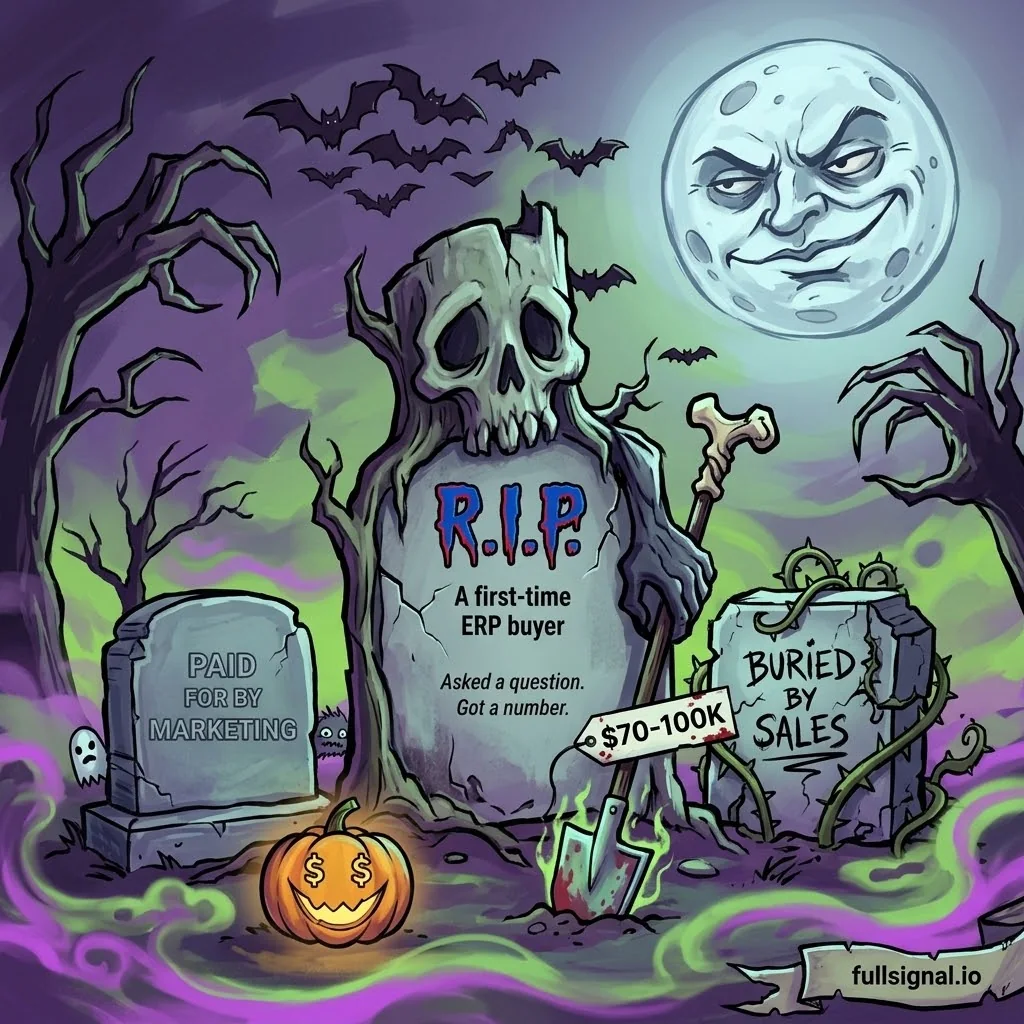
If your BDMs are doing cold outbound, you have a marketing problem.
Your BDMs are the most expensive resource in your go-to-market team. Every hour they spend finding a buyer is an hour they aren't selling to one.
 David ReecePrincipal, Full Signal
Boil marketing down to one objective and it's this: feed sales with qualified demand. Virtually everything else is secondary. The brand work, the events, the content and the campaigns all earn their place by what they contribute to that one outcome.
So when your BDMs are spending their week cold calling, it's worth asking a blunt question. Why is the most expensive person in your go-to-market team doing the job marketing exists to do?
The demand is already out there
I analysed 259 search terms Australian businesses use to research and buy ERP. Together they draw over 56,000 searches a month.
56,000+
searches a month across 259 terms Australian businesses use to research and buy ERP
Closer to a decision: searches a month
Not all of that is a buyer ready to sign. About half of it sits on broad terms like "erp" and "erp system", where plenty of searchers are students and people learning the category. But a lot of it is much closer to a decision:
- Buyers searching for the capability, not the category. "Inventory management software" draws 2,500 searches a month, "warehouse management system" 1,100 and "mrp software" 900. A manufacturer replacing a system often never types the word ERP at all.
- Buyers who have to move. "MYOB Advanced pricing" alone draws 1,400 searches a month, years after the product was renamed. End-of-life searches on legacy platforms come from buyers with no choice but to change.
- Buyers who have chosen a platform. In the NetSuite and Odoo ecosystems, buyers search for an implementation partner in real volume.
Capturing that demand, and the buyers within it who are ready to talk, is marketing's job. But 55% of Australian ERP implementation partners don't appear on page 1 of Google for ANY of those keywords. They're effectively invisible to the market.
55%
of Australian ERP implementation partners don't appear on page 1 of Google for any of these terms
- On page 1 for at least one term
- Not on page 1 for any
So the BDMs pick up the phone.
What cold calling actually costs
And cold calling is tough. Cognism's 2025 report put the industry rate at about 2% of conversations ending in a meeting. My experience in ERP is it's closer to 1%. That's around 300 dials to land 100 conversations for one meeting. Roughly a full week's work, if you're using a dialler.
For a BDM on $130k plus super, that's $3,150 to land one meeting.
One meeting, sourced cold
~1 week
of a BDM's time, with a dialler
$3,150
per meeting, on $130k plus super
Four meetings a month, all sourced cold
Left for discovery, demos and proposalsNothing
Now scale it. If a BDM needs four new first meetings a month and every one of them is sourced cold, the dialling alone fills the month. There's no time left for the discovery, demos and proposals that actually close business.
Every hour a BDM spends finding a buyer is an hour they aren't selling to one.
Cold meetings are the least likely to close
And those meetings are the least likely to convert to revenue. One analysis of lead data from hundreds of companies found website enquiries closed at more than 15 times the rate of cold lists.
15×
Website enquiries closed at more than 15 times the rate of cold lists
That gap makes sense once you consider who is on the other end of the call. A buyer who wasn't looking has no internal case for change. Deals that start that way are the most likely to stall and go quiet without a decision. When they do reach a decision, they tend to end on price, because the buyer wasn't looking for you and has little reason to value you over the cheapest option.
The vendor referral cushion
Plenty of partners are insulated from the commercial impact of this inefficiency because their vendor sends them referrals. Referrals are always welcome, but the rate and quality are set by someone else and can change at any time. Vendors revise their channel programmes, shift their own sales priorities, and sometimes decide to sell direct.
Referrals are always welcome, but the rate and quality are set by someone else and can change at any time.
Some partners compete directly with their vendor, and in that dynamic, you can always expect the cream to stay with the vendor's sales team.
If the vendor is your primary lead source, the truth is you're not in control of your own growth.
What a buyer of your business will look for
And when you come to sell the business, a buyer will discount your multiple if you can't show you generate your own demand, reliably and repeatably.
Demand your business generates on purpose is an asset they can buy.
Private equity is active in the ANZ ERP channel, and consolidation is the exit route many owners are planning for. An acquirer will look hard at where your pipeline comes from. Demand that depends on a vendor's goodwill, or on a few people working the phones, can disappear overnight. Demand your business generates on purpose is an asset they can buy.
Where outbound belongs
Outbound has its place when marketing is already warming the accounts you're calling. A prospect who knows your name, has read something useful from your team or has been on your site is a very different call from a name on a list.
But it should never be the fallback your highly paid closers rely on when the leads in your CRM run dry.
Where to start
Three questions will tell you how big the problem is.
- Where did last quarter's opportunities come from? Ask your BDMs to tag each one: inbound, vendor referral, or found themselves. If the last group is the biggest, you have your answer, and it took ten minutes.
- How many hours a week are your BDMs prospecting? Multiply that by what they cost you. That's your current spend on lead generation, through the most expensive channel you have.
- Are you visible where your buyers search? Search for your platform, the problems you solve and the industries you serve, the way a buyer would. If the vendor, the review sites and your competitors appear and you don't, that's demand going elsewhere every month.
Then start where the return is quickest. Capture the buyers who are already searching before spending on anyone further up the funnel. And measure it the way a CEO should measure any marketing investment: does it produce more pipeline and closed deals than it costs, once the sales effort to close them is counted? When it does, you've earned the confidence to invest in the next stage.
Your fair share
So before you hire another BDM, find out one thing.
Are you getting your fair share of the 56,000 searches a month?
A shorter version of this piece first appeared on LinkedIn.
Sources
- Cognism, State of Cold Calling Report 2025.
- Implisit lead source analysis, published on the Salesforce blog, 2014.
- Search volumes from Ahrefs Keywords Explorer, Australia, read 19 October 2026.
- Page-one presence read on Google Australia, 19 and 20 October 2026, across 139 scored Australian ERP implementation partners.
Written by
About David