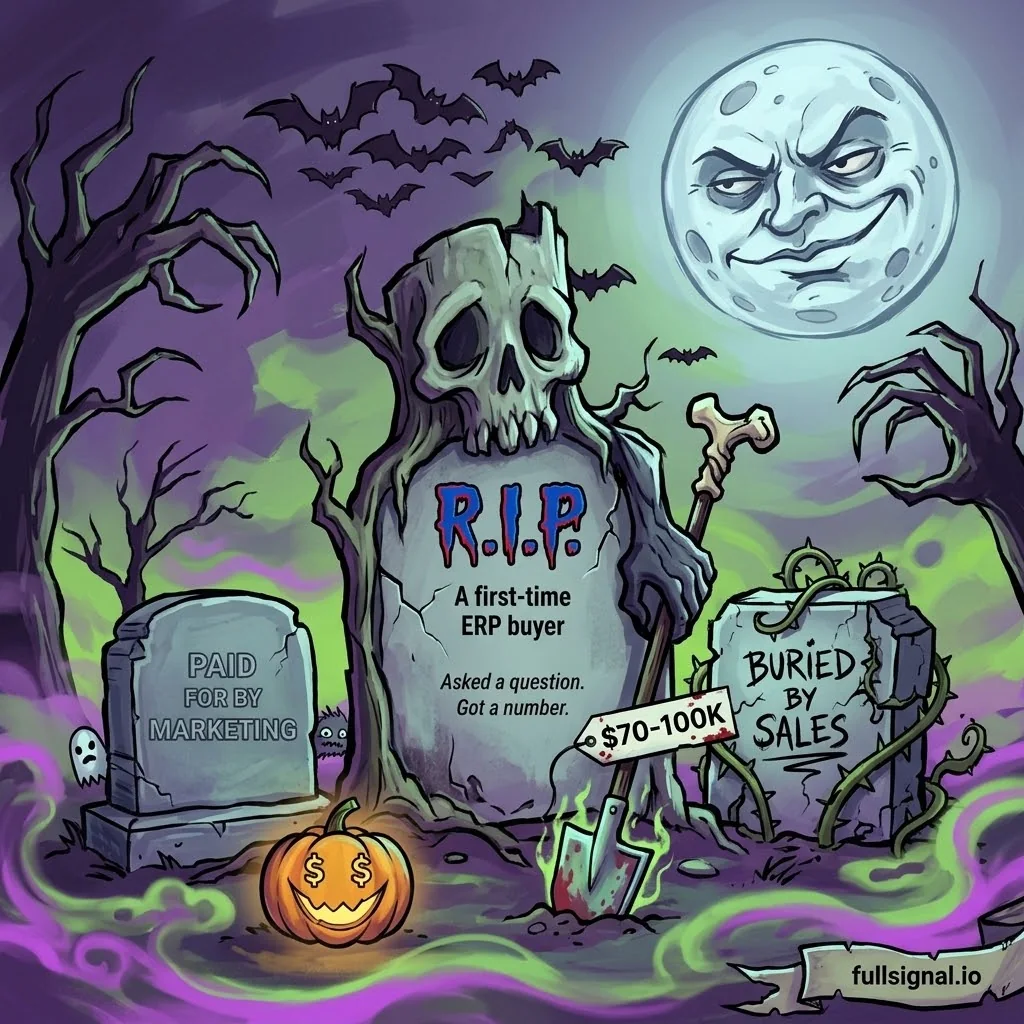
They're not buying you. They're buying the platform you happen to sell.
By the time an ERP buyer is talking to an implementation partner, the platform is already on their shortlist. The vendor's brand may have got you the meeting, but it won't close the deal.
 David ReecePrincipal, Full Signal
By the time an ERP buyer is talking to an implementation partner, the platform is already on their shortlist. They've seen the demos, read the comparisons and probably sat through a vendor webinar or two. More often than not, you're in the room because you're the means to an end.
That's an uncomfortable position to sell from. The platform has their interest, but you don't have their confidence. They've never heard of your business and they know nothing about the track record of your team. You still need to convince them the platform is the right choice, whilst also building confidence rapidly in the value you and your team will bring.
If you're lucky, you've got a handful of meetings to make both land, on what's likely the largest software purchase they've ever made.
The vendor's brand gets you the meeting
The vendor does a lot of work before you arrive. Its marketing created the interest, its reputation earned the platform a place on the shortlist, and its sales team may well have made the introduction. That tailwind is real, and it's a big part of why the channel model works.
But the moment the conversation turns to who will implement the platform, the tailwind drops away. The buyer is now weighing a decision that rests on a team they met last week. Their questions change: will these people understand how we work, will they get it right first time, and what happens if they don't?
The vendor's brand may have got you the meeting, but it won't close the deal.
That's the real challenge for a channel partner. How do you build trust and credibility fast, without the tailwind of a strong reputation or brand equity of your own?
Why the usual credentials cancel each other out
Partners typically reach for the industry staples: the vendor designation, the awards, the years in business, the number of clients, the years of experience in the team.
They matter. A buyer will look for them, and a gap in any of them can count against you. But they're the table stakes of the game, and a dozen of your peers in the same ecosystem can make the same claims (or better).
Look at it from the buyer's side of the table. Three partners present in the same fortnight. Each one has the vendor's top designation, a row of awards and a client list that runs to the hundreds. By the third presentation the credentials have stopped registering. To a buyer who can't tell you apart, they cancel each other out.
And when a buyer can't tell partners apart, they fall back on the one thing they can compare: price. You end up in an eleventh-hour price negotiation, discounting away your margin to win a deal that should have been won on value.
Differentiate on what's actually yours
The way through is to differentiate on the things that are actually yours, and make the buyer better off while you're doing it.
Every partner has two assets that nobody else in the ecosystem can claim: the problems they've already solved for their customers, and the people who solved them. Both can be put in front of a buyer long before the contract is signed.
Show them businesses that look like theirs
The first is to show the problems you've solved for businesses that look just like theirs.
That means a bank of case studies with quantified outcomes, and enough operational detail that the buyer can see their own situation in your successes. A logo and a one-line quote won't do it. The buyer is looking for proof that you understand how a business like theirs actually runs: how stock moves, how jobs are costed, where the month-end close gets stuck.
A case study that does that job covers:
- The business: its industry, its size and the way it operates
- The problem in operational terms, described the way the customer described it
- What changed in the way they work, and how your team got them there
- The outcome, quantified: time saved, cost removed, margin recovered
- The customer, in their own words
One or two won't cut it. Depending on the variety and complexity of use cases in an industry, you may need up to a dozen. A distributor running two warehouses and a distributor running twenty have different problems, and a buyer will notice quickly if your evidence only covers one of them.
Built properly, that library earns its keep at every stage of the deal: in the first meeting, in the proposal, and in the reference calls at the end.
Let them experience your team before they sign
The second is your own delivery team.
Whenever I've spoken to happy end-user customers, the consistent theme was not how much they loved the software, it was how much they valued the experience of working with the implementation team. The confidence of dealing with experts who had real depth in their industry, a genuine interest in the welfare of their business, and the leadership to push them and advocate for change.
That's what the buyer is really trying to assess across those few meetings, and it's the hardest thing to judge from a sales presentation. So why not give them a taste of what working with your team is like, before they commit to a six-figure deal?
Package a piece of your professional services
Every partner has a powerhouse of expertise in its professional services team. They analyse, diagnose, re-engineer process and find the operational inefficiencies before a single licence is deployed.
Carve off a small piece of that and package it as a deliverable that quantifies real opportunities to save money, improve margin or lift productivity.
A few things make it work:
- A tight scope. A fixed piece of work over a short timeframe, with a defined output the buyer keeps whatever they decide.
- The right people. Have it delivered by the consultants who would lead the implementation, so the buyer meets the team they'd actually be working with.
- Their numbers. Findings specific to their business: their processes, their costs, their opportunities, each one quantified.
Done well, it changes the conversation. The buyer now holds a quantified case for change in their own business, prepared by the people who would deliver it. None of the other partners has given them anything like it.
Build trust before the deal is signed
That's how you build trust before the deal is signed. Not by telling them what you've won, but by showing them what you'd do.
A shorter version of this piece first appeared on LinkedIn.
Written by
About David