Ballparking on the first call is burying your pipeline
A BDM at capacity drops a big number on the first call to sort the serious buyers from the rest. It's rational at their desk, and it's quietly destroying leads your business paid for.
 David ReecePrincipal, Full Signal
At our peak, my team at MYOB generated more than 75% of the demand our channel partners closed. That's a lot of leads flowing into a lot of partner businesses, and for a while it looked like exactly the problem every partner wants to have.
Then some partners hit capacity. They couldn't onboard demand as fast as it was arriving, and a particular behaviour started to spread through their sales teams. On the first call, before anything else had happened, the BDM would drop a number.
That's ballparking. And in high ticket ERP sales, it's one of the most expensive habits a sales team can have.
Why BDMs do it
I've been a BDM, and I get the logic. I'm at capacity and can't take on any more leads, so I'll sort the Lindt from the lollies. Drop a big number on the first call, something like "you're probably looking at seventy to a hundred grand", and see who's still on the line. Anyone who doesn't hang up is likely to close fast.
For a BDM who's flat out, it's rational. It protects their time and finds the buyers at the pointy end of the process.
But what's rational at the BDM's desk is destructive at the P&L. Many of those leads had already been qualified before they ever reached the partner. The business had invested in getting them there. And ballparking happens at the worst possible moment, the most delicate stage of the buyer journey, when the prospect has barely started telling you what they need.
What's rational at the BDM's desk is destructive at the P&L.
Most of these buyers have never done this before
In my experience, more than 40% of mid-market ERP buyers are buying their first ERP. They don't know what they don't know, and they've never spent six figures on software and services before.
40%+
of mid-market ERP buyers are buying their first ERP, and have never spent six figures on software and services before
There's a reason vendors like NetSuite and MYOB don't publish price lists. Price varies enormously from one business to the next, particularly on the services side, and a final quote needs proper discovery. Buyers know they can't find a number, which is why "MYOB Advanced pricing" alone draws 1,400 searches a month in Australia.
So a first-time buyer arrives on that first call with real pain, no reference point and a lot of uncertainty. Give that buyer a number before anyone has quantified the problems they're solving, and one of two things happens.
A number on the first call, before discovery
Outcome one
The jump scare
Sticker shock. Nothing yet to weigh the number against, so all they hear is the biggest figure their business has ever been quoted.
Outcome two
The anchor
The guess becomes the reference point. Once the full scope is known, the real figure lands higher, and confidence goes with it.
Outcome one: the jump scare
Some get sticker shock. They haven't seen the return yet, or the cost of leaving the problem unsolved, so the number has nothing to stand against. All they hear is the biggest software and services figure their business has ever been quoted.
A first-time buyer needs a considered investment of time building that value: understanding their problems, quantifying them, and showing what solving them is worth. The ballpark skips all of it and asks for a reaction to the price alone.
Outcome two: the anchor
The rest now have an anchor they won't forget. The trouble is that a number given before discovery is a guess.
Once integrations, data migration and the full scope are understood, the real figure might land well above the ballpark. By then you've invested considerable time in the opportunity, and the buyer has been carrying the first number around their business the whole time. You promised a treat and handed them a trick, and their confidence goes with it.
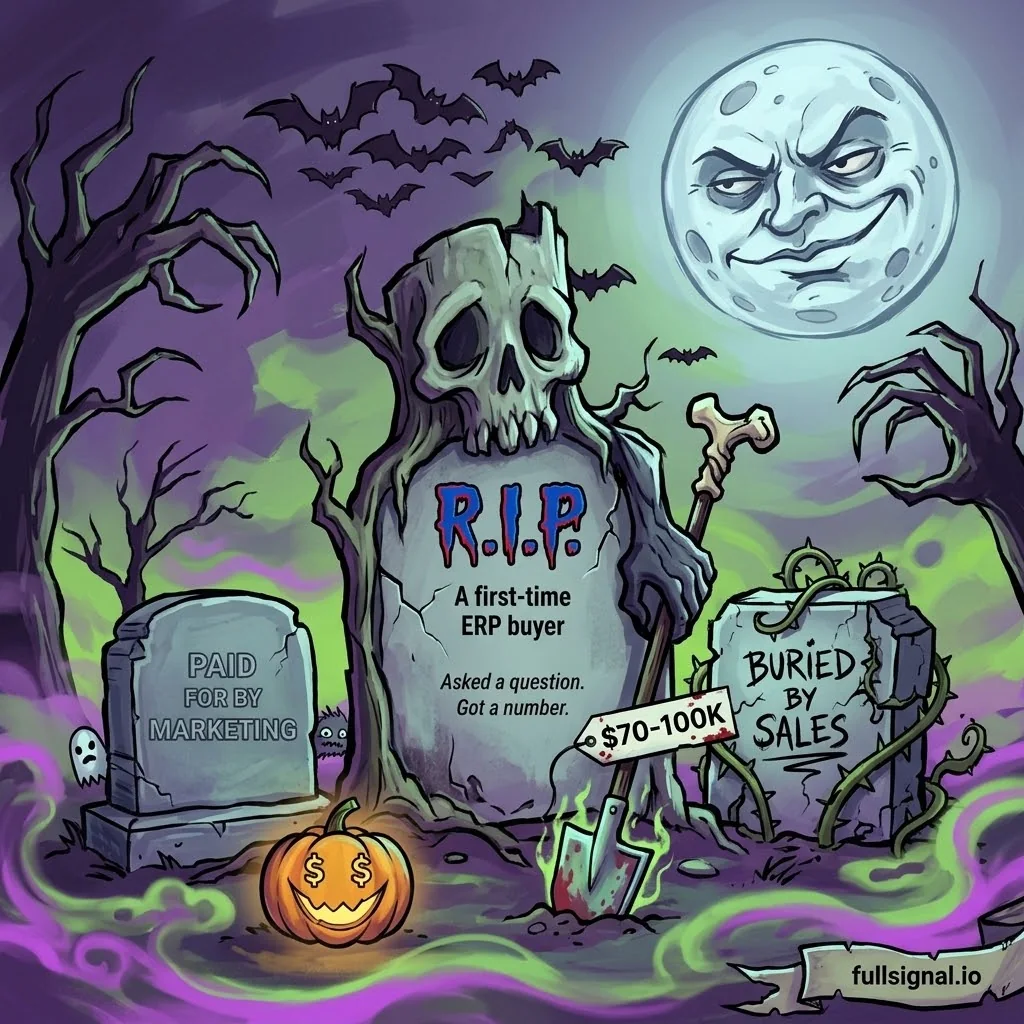
Either way, the lead ends up in an expensive grave. Paid for by marketing, buried by sales.
Paid for by marketing, buried by sales.
Plenty of leads aren't ready for a number at all
Step back from the first call and look at where a new enquiry could actually be. In high ticket, long cycle ERP sales, a prospect could be:
- Stage 1Still working out what problems they're solving.They know something's wrong but haven't defined it, let alone sized it.Not ready for a number
- Stage 2Investigating whether software is the answer.They're exploring, often for the first time, what an ERP would change.Not ready for a number
- Stage 3Choosing between two or three shortlisted platforms.They've done some homework and want to compare.Not ready for a number
- Stage 4At the business end.The platform is chosen and they're now shortlisting implementation partners.Ready to talk numbers
Only the last group is ready to talk numbers. Ballpark everyone, and you're proposing marriage on the first date.
Meet the prospect where they're at
The answer is to equip your BDMs to meet each prospect at whatever stage of the journey they're at, and to show up as a trusted advisor at every one of them. Depending on the stage, that might mean not selling at all.
A prospect still defining the problem needs help defining it. One investigating software needs to understand what changes and what it's worth. One at the business end needs confidence in the team that will implement it, which is a different conversation again, and one I wrote about in They're not buying you. They're buying the platform you happen to sell.
None of those early conversations needs a price. All of them need your BDM to bring something useful to the table.
An offer that sits upstream of the sale
This is where an offer upstream of a formal software buying process makes sense: something that helps the prospect define and quantify the impact of their pain, before anyone is talking about software.
The classic version is the "health check", but most buyers now see that as a sales tactic, and they're usually right.
A recent example I created with a client was a Margin Leak Diagnostic. It was a short consulting engagement that analysed exactly where the prospect's business was losing margin. Nothing to do with software, no cost to the prospect, and no obligation to progress a sales process.
It was designed as a stepping stone between "you've got some financial and operational pain" and "you need a six figure investment in software and services". It gained traction off the back of a webinar, and it generated real excitement inside the client's business, because for the first time their team had something genuinely valuable to offer a prospect who wasn't ready to buy.
And the result changed the conversation. There was now quantified value on the table, specific to the prospect's business and operations.
Price will always come up
None of this means hiding the price. Dodging the question frustrates buyers just as much as ballparking scares them, and a deal where price never comes up rarely closes.
The difference is timing. By the time the number arrives, you want to have built enough value that when the prospect sees it, their only response is "that makes sense".
The cost of a fast filter
So ballpark on the first call and you might find some fast deals.
But everyone else will be pipeline you paid for and threw away.
A shorter version of this piece first appeared on LinkedIn.
Sources
- Search volume from Ahrefs Keywords Explorer, Australia, read 19 October 2026.
Written by
About David